Saturday, February 24, 2007

Review -- Running with Scissors


The Work:
Running with Scissors

The Artist(s):
Directed by Ryan Murphy. Starring Annette Benning, Alec Baldwin, Brian Cox, Gynneth Paltrow, Joseph Cross, Joseph Fiennes.

Description:

Young Augusten Burroughs (Cross) is given to the custody of his mother’s psychiatrist (Cox) after his alcoholic father (Baldwin) and nutso mother (Benning) split up. He comes of age, so to speak, in the wacky, dysfunctional household of his mother’s psychiatrist.

Purpose:
This movie is trying hard to be cool. Trying hard in the way that Brad Pitt tries hard. Trying hard in the way that Tom Cruise tries hard (he tries the hardest!). Interesting that I should mention Pitt, since he’s one of the producers. Based on Augusten Burrough’s memoirs (which of course a guy like Pitt would read and revere—I’ll bet Pitt has a whole shelf of Bukowski in his bedroom, don’t you?) this movie his supposed to give you insight into a world of brilliance and dysfunction, it tries to convey what it means to be sane in an insane world. Or be insane in a sane world. Oh, it’s also a love story of sorts. And a story of redemption. And a story about building shrines to poop. And a story about Gwynneth Paltrow murdering the cat and then cooking stew with Bo Derek-style cornows. Did I mention the gay love affair between the young Augusten and a 35-year-old schizoid? Did I mention Annette Benning chewing the scenery and bedding housewives? Okay, I’ll admit; I don’t know what the heck this movie was trying to do. You can’t blame Alec Baldwin’s character for his lush-hood; after ten minutes of this movie I wanted to reach into the screen and steal his bottle of scotch.

What Works:
Okay, I have to say something nice here. I think Joseph Cross gives a good performance as young Augusten. By good, I mean he doesn’t annoy me as much as the rest of the characters. Baldwin is okay, too, but he’s only onscreen for ten or fifteen minutes, tops. It’s pretty much all Benning, all the time. Since the movie centers around Benning, I have to say something charitable about her performance. Okay…remember her turn as the repressed housewife in American Beauty? She’s much louder in this movie. Much, much louder. Shrieking to the rafters loud. Looney-tunes loud. Oh, and she slowly transforms in into Shirley McClaine, complete with the bad mullet and the pseudo-poetic astral phraseology. Only difference is, they keep locking up Benning’s character instead of giving her book deals. The bad part is, they keep letting Benning’s character out so that she can participate in yet another cringingly bad set piece that starts with her being cheerful and ends in more screaming.
What Doesn't Work:
I think I can still hear Annette Benning screaming. Seriously, the fatal flaw in the movie, the one thing that contributed most to its undoing, is this: the characters are repugnant. As a viewer, you’re rooting for young Augusten to survive this hell, no question. And that’s a fine premise for a movie. Position his abusers as villains, fair enough, now we’re engaged. Instead, the movie continues, relentlessly, to try to get us to sympathize with Benning and Cox, two self-absorbed nut jobs. They chew whole scenes, the two of them, and we don’t see Augusten at all. What happened to Augusten? And we wonder, again and again, “what’s this movie about, anyway?” If you’re asking that question after thirty minutes, a movie is probably in trouble. I was asking that question even as the final credits rolled.

Verdict:
Don’t waste your money. I kept wishing that a big oil tanker would break loose from a Sylvester Stallone film, crash into the psychiatrist’s house, and incinerate the entire cast.

Friday, February 23, 2007

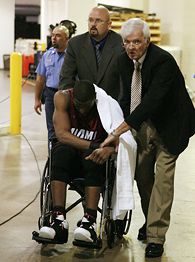
Dwayne Wade's Shoulder Separation


The Work:
Dwayne Wade's Wheelchair Exit

The Artist:
Dwayne Wade

Description:

Dwayne Wade was injured the other night in a game against the Houston Rockets. He got hit, he separated his shoulder, and then? Well, the rest was vintage D-Wade histrionics. Nobody does it better than D-Wade. Michael Jordan used to grimace quite a bit, and Manu Ginobili can certainly sell a charge with the best of them, but this? This was D-Wade taking the "it hurts so bad, ladies" face to a new level. He didn't just grimace; he cried literal tears! He went off on a wheelchair! A wheelchair, my friends. For a shoulder separation.

Purpose:
It's widely believed that the Heat won the NBA title last year in large part because the referees started calling a foul every time a defender even looked at Dwayne Wade. Wade himself seemed somewhat surprised at the lopsided refereeing, but like any good competitor, he immediately set out to exploit this new advantage, and in the process he unveiled a dazzling array of "I've been fouled!" scowls, pouts, and preens. However, many observers around the league felt that Wade peaked during last year's finals. He'd reached the pinnacle of the NBA crying game; he'd singlehandedly restored everyone's belief that the league was fixed. How do you top that? This was the challenge Wade was facing coming into this season, and last night's performance was Wade's attempt to remind us all that he is our generation's Master Crybaby.

What Works:
You've got to see it to believe it. The incredulity on his face, as if the pain is mounting to volumes beyond human endurance; the tears rolling down his cheeks, the slow (it's always slow) rolling away of the wheelchair. It's a master in his prime.

What Doesn't:
Don't think too much; let yourself be swept away in the emotion of the moment. Don't let yourself wonder why he would need a wheelchair for a separated shoulder. Just go with it, man.

Verdict:
Listen, I know the guy was hurt. Nobody likes to see a player get injured. But this is not about the injury itself, this is about the reaction, and nobody, but nobody, reacts to pain more eloquently than Wade. This is perhaps the most representative moment in the NBA so far this year. Forget Steve Nash and the Suns, forget Kobe and the Lakers. When it comes down to crunch time, the tears of a superstar availeth much.

Black Steel in the Hour of Chaos

The Work:
Black Steel in the Hour of Chaos

The Artist:
Public Enemy

Description:

A song about a young man who is given a draft letter but refuses to go fight for a "white" America. He is imprisoned for his defiance, and while in prison he hatches a plans a prison break with the help of a pre-VH1 Flava-Flav and the S1Ws, a paramilitary organization that was associated with Public Enemy at the height of their popularity.

Purpose:
It's a pop song; at the most basic level, its purpose is the same as any other commodity...to sell. However, Public Enemy, particularly Chuck D, have always maintained a certain amount of artistic credibility. You have to believe they were going for something more here. The message is about anger and despair in the African-American community. The song itself is like a story from a graphic novel; Chuck D uses vivid imagery throughout to convey a sense of wild bravado. It's a song about big acts committed by big personalities as they battle evil forces.

What Works:
Just about everything, from the piano sample to Flava-Flav's nonsensical ramblings (does he do anything else?), here muted and moved to the background so that they sound like the musings of Chuck D's insane alter ego. The images are particularly vivid: "The joint broke from the black smoke" or, "I got a raw deal, so I'm lookin' for the steel." Even the coda, repeated over a thumping, fuzzy baseline, has resonance, as it points to the song's ultimately hopeless ending: "death row, what would a brotha know?"

What Doesn't:
Nothing. Not a thing. Some think the Geto Boys' "Mind Playing Tricks on Me" is the greatest rap song of all time. I'll take this one.

Verdict:
A groundbreaking song from a groundbreaking group that sounds better now (not just becaue it's on your iPod) than it did back in the day when you bumped it in the cassette deck of your Ford Escort GT. Which, by the way, did have a spoiler.

IMAX IS BIG

IMAX is big! It's so big you can see Peter Parker's contact lenses in the IMAX release of Spiderman 2. Oooops, wasn't he supposed to ditch those glasses for the improved eyesight afforded by his new superpowers? I feel betrayed by the super sizing of standard films, blown up to Brobdingnag proportions for the big big screen.

I can remember when the IMAX theater was built here in St. Augustine. Didn't really know what was going in the rest of the World Golf Hall of Fame building, but boy you could tell which end was the IMAX—that great conspicuous box of architecture could be none other than the magic it would project inside—six-story-high film screen and a sound system of complete immersion. Then they dropped the temperature about 100 degrees and brought in filmmaker, David Brashears, to introduce Everest, the inaugural film. You felt like you were there, no doubt about it. (Also, Brashears nearly fell off his presentation platform in an ironic folly which only enhanced the Oh my, how did he ever survive it! effect.) Brashears filmed in IMAX with IMAX cameras and made his subject as big as it could be. He took cinematography to the summit and didn't settle for standard gage to take on the largest mountain in the world.

Then along come these conversion films, the Disney classics up-scaled into a flock of grainy color dots which come across like a documentary on Technicolor locusts. The montage scenes of Beauty and the Beast capture the sweeping grandeur of animation and simultaneously distract from it with a mosaic of still characters that stare rudely unblinking from the background. They are people as wallpaper, though I daresay we never noticed their lack of movement at the scale for which they were designed.

The modern style computer animation translates well. The Polar Express, for example, was a no brainer, but it was a no brainer to start with.

Here's hoping the conversion technology improves to take standard movie format into the IMAX arena. Or at least let's hope Daniel Radcliffe has a real close shave before he appears next as Harry Potter, this time in IMAX.

GARDEN ASHES

Last year I bought a potted palm tree at the beginning of Lent and by Easter, it had one frond left. I can kill a houseplant at a glance. Had to get some new plants for Pentecost. At first they looked like they’d never lost a leaf in their lives—healthy, vibrant specimens! Now they’re rather honest looking life forms. They bear the color green as if it were a tentative hue, subject to change at any moment. They look like they’ve experienced stress. They look like me! Most of them are in rehab. at my mother-in-law’s house.

And now we enter, yet again, into the season of Lent. I find Biblical trees very interesting subjects. They play characters unto themselves though are largely unrecognized, from the Tree of Knowledge, to the sycamore Zacchaeus climbed, to the tree upon which Jesus hung. If in the beginning was the word and the word was God, then trees were the most damned race of beings ever invented. Maybe if we go to Hell we grow up as a tree, the fodder of flame. Or maybe we’ve made a huge error of printing medium. Probably we were supposed to use stone as God did for the Ten Commandments. Probably that’s what the eleventh commandment said: “Thou shalt use rocks on which to build My laws.” Rock, paper, scissors? Ah, metal. Wasn’t it Joseph Smith of the Latter Day Saints who had the tablets of gold? When I get to Heaven (if) then I shall open the bedside drawer and see what stationary the Gideons have left.

WHAT'S WRONG WITH THE POLAR EXPRESS

It’s horrifying. That’s what’s wrong. It’s the indoctrination of children into a workaholic world where industrial society is idealized—a huge city with a huge factory is the North Pole with thousands of clone elves who work facelessly right through Christmas to pile commercial goods into a big bag. It’s Wal-Mart’s underpaid on the silver screen! And how do the children arrive there? By commuter train, why else? This train, the “Polar Express,” stops in the suburbs of middle class America to pick up children, but only those who need something to believe in so they can grow up to carry on this kind of automated lifestyle. Presumably those little ones who already mindlessly believe are suitable to go to work in retail and are left at home to sleep. It’s the thinkers—those who doubt—who need to see what a wonderful life it is in an empty city except where there is commerce at hand. Scrooge would have applauded this movie in his unreformed days. It does deviate from typical commuter culture in that hot chocolate is served on board the train and the children actually form relationships. These two elements I did find hopeful, but did I mention the movie is flat dull? The only way for me to keep awake through it is by explicating these evil social implications. There are a handful of minor conflicts, each of which is quickly resolved so the tension is not fully developed throughout. The biggest nail-nibbler is when the protagonist loses a bell through a hole in his pocket—this is no show for the poor children, oh no, these children must keep their clothes in good repair or there is no magic of Christmas. Christmas is conditional. The great Santa gives the protagonist a break on this season, but tells him to mend the pocket. There I go again. Okay, so the movie brings us into a magical world (much like Harry Potter movies), but it doesn’t particularly do anything with us once we get there.

I found March of the Penguins a more honest movie, though I doubt it would have been very appealing in pre-industrial society. It is interesting because it is allegorical. March doesn’t ask questions, but it leaves them for us to find—questions such as, how could a group of animals develop a lifestyle so difficult and live in such difficult conditions? And WHY DO YOU TAKE SUCH A LONG COMMUTE!

Give me a nice hot mug of Dickens and I’ll go back to bed.

JAMES BLOND

Where is glib? This is my primary issue. Of course I live for the puns and terrible jokes, the rich foreplay of chauvinism, which have buttered the impenetrable masculinity of Ian Fleming’s leading man on screen for decades.

I can respect Casino Royale as a reset to the beginning and a return to the book. Judi Dench as “M” brilliantly assists in the transition, merging recent old with new old. She’s all there, no question, but the rest of the movie is congealed of half-cross lines which don’t meet up in any kind of believable chemistry. Daniel Craig comes on as serious as the Seventies—now there’s an oxymoron! The train scene is closest to traditional film Bond where he’s undressing Vesper Lynd with his analysis of her clothes, but the scene goes stale with monologuing. I’m too bored to be convinced that he’s attracted to her here, nor am I subsequently swayed to believe he’s in love, ready to give up his career, his body, become pregnant and settle down as a stay-at-home dad. No, I just can’t cash that Bond. The plot is there, but incorrectly played through dialogue.

And what of John Qleese? I Wanda where he went? Nearly Headless Nick was completely non-corporal here. No funny walks, no funny cars to disassemble in description made for a Fawlty film.

Plenty of action, I’ll credit that. Craig shows himself (a lot of himself) to be in shape, not just in a tuxedo. The movie starts with foe and hero in some kind of Jackie Chan Olympic try-out. And I’ll credit director, Martin Campbell, for finding the only fuel truck in Hollywood not to explode. I’m probably more breathless with surprise from that than from the action sequences.

As far as a retrofit to the book, Craig fails to take the character off the page and project him into a three-dimensional person. The movie leaves me shaken, not stirred.